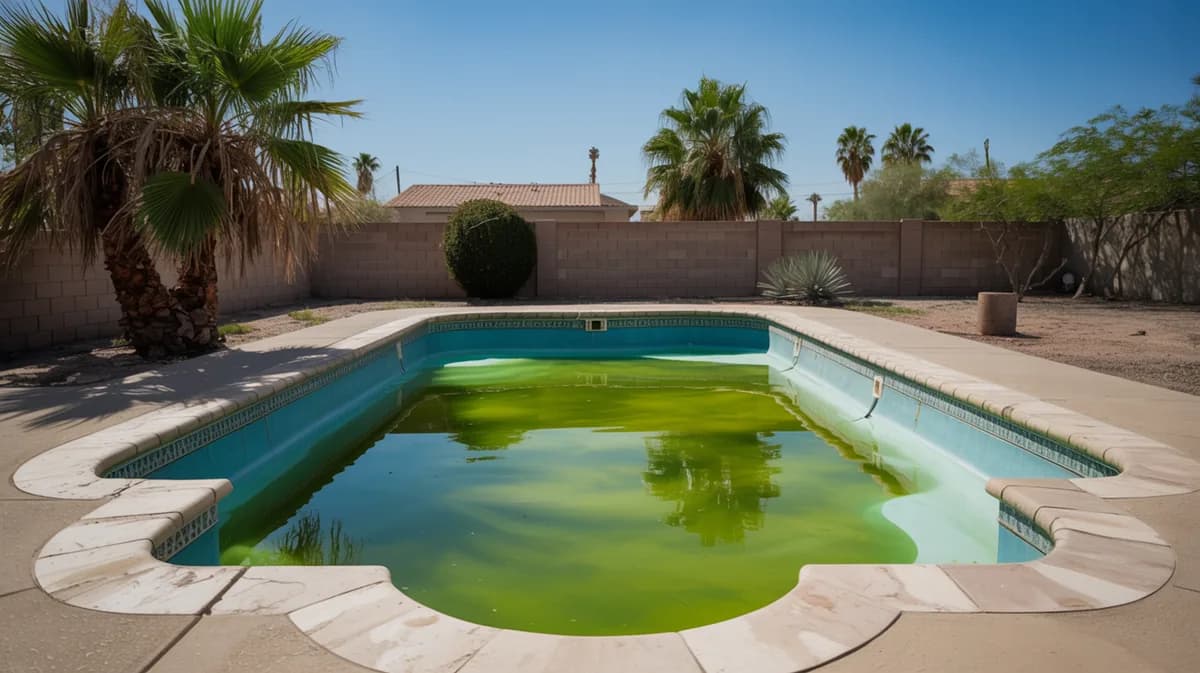
A pool can go from clear to green in Arizona faster than almost anywhere else in the country. Two days of neglect in July can do what would take two weeks in a milder climate.
That is not bad luck. It is the specific combination of heat, sun and evaporation we have here — and once you understand which of those is actually causing your problem, fixing it stops being guesswork.
Why it happens so fast here
Three things stack up:
Water temperature. Algae multiplies faster in warm water. Arizona pools spend months well above the temperature where algae growth accelerates, which shortens the window between "a bit off" and "visibly green" to a matter of days.
UV destroying your sanitizer. This is the big one. Direct summer sun can destroy the majority of unstabilized free chlorine in a single day. If your stabilizer level is low, the chlorine you added on Saturday is largely gone by Sunday — and the pool spends the rest of the week undefended.
Evaporation concentrating everything else. Water leaves; dissolved solids stay. Over a season this drives calcium hardness and stabilizer upward, and past a certain point the water stops responding to chemistry at all.
First, work out which problem you actually have
Green water and cloudy water are not the same failure, and treating one as the other wastes weeks.
| What you see | Usually means | Where to start |
|---|---|---|
| Green tint, water still clear-ish | Algae getting established; sanitizer losing | Shock + brush + run filter |
| Green and cloudy, can't see the floor | Algae bloom well underway | Extended treatment, possibly drain |
| Cloudy but not green | Filtration, not chemistry | Filter condition and flow |
| Clear water, green/grey surface stain | Algae stained the plaster | Surface treatment, not chemistry |
| Clears then returns within days | Underlying cause not fixed | Test stabilizer and circulation |
That last row is the one worth dwelling on. A pool that goes green again a week after being cleared does not have an algae problem — it has a sanitizer-survival or circulation problem that nobody addressed.
The actual fix for a green pool
When the water is green and the plaster underneath is sound, the sequence is:
1. Test before you touch anything
Specifically: free chlorine, pH, total alkalinity, and cyanuric acid. That last one explains more green pools than anything else, and most people never check it.
pH matters more than people expect too — chlorine's effectiveness drops sharply as pH climbs, so shocking a pool with high pH wastes much of what you add.
2. Correct pH first, then shock
Shocking into out-of-range water is throwing chemicals at a problem that will neutralize them. Get pH into range, then shock — and shock properly. Under-shocking is worse than not shocking, because it kills some algae, breeds tolerance in the rest, and leaves you convinced the treatment does not work.
3. Brush everything, repeatedly
Algae holds onto surfaces, and especially onto rough or aging plaster. Brushing lifts it into the water where the sanitizer and filter can actually reach it. This step gets skipped constantly and it is the difference between a pool that clears in three days and one that never quite does.
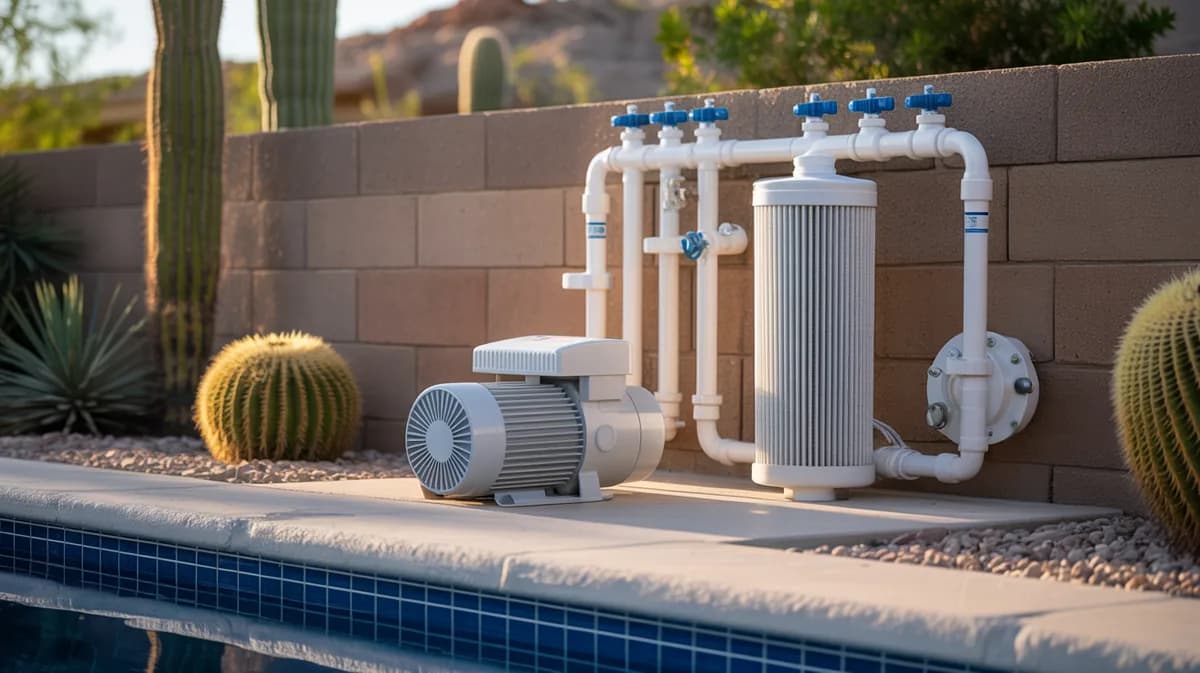
4. Run the filter continuously
Not the usual schedule — continuously. The filter is what physically removes the dead algae, and this is the stage where the water often turns cloudy grey. That greyness is progress: it means the algae is dead and suspended, waiting to be filtered out.
Clean or backwash the filter as the pressure climbs. A loaded filter stops removing anything, and this is exactly when it loads fastest.
5. Retest and hold
Once clear, keep chlorine at the top of its normal range for several days. Algae that is 95% dead comes back.
When treating it is the wrong answer
Sometimes chemistry is not the economical path.
When stabilizer is far too high. Cyanuric acid does not evaporate or break down meaningfully — it accumulates. Above a certain level it locks up your chlorine, and there is no chemical that removes it. Dilution is the only fix, which means a partial or full drain.
When dissolved solids have maxed out. Same logic. Past a certain concentration the water simply will not respond, and you can spend more on chemicals fighting it than the water is worth.
When the plaster is stained. Here the water clears fine, but the surface stays discolored — a grey, brown or green shadow that brushing will not lift. That is not a chemistry problem any more; it is a surface one, and it is what acid wash exists for.
The honest test: if you have cleared the pool twice this season and it keeps going back, stop buying chemicals and get the water tested properly. You are likely treating a symptom.
How to stop it happening again
Almost every green pool traces back to one of four things:
- Stabilizer out of range — too low and chlorine burns off daily; too high and it stops working. Test it seasonally, not never.
- Circulation dead spots — a pool that does not turn over fully has corners where algae establishes first. Watch for it starting in the same place each time.
- A loaded filter — high pressure means low flow means poor turnover. Learn your filter's clean baseline and clean it when it rises above that, not on a calendar.
- Falling behind after a storm — a monsoon dust and debris load consumes sanitizer fast. The days after a storm are when a pool most needs attention and most often does not get it.
None of these are exotic. They are just easy to miss when the pool looks fine, which it does right up until it does not.
When to call someone
Call if: the pool has cleared and gone green again this season, you cannot see the floor, the surface stays stained after the water clears, or you are on your third round of chemicals with no progress.
That last one is worth taking seriously. Repeatedly buying chemicals for a pool that will not hold is usually more expensive than the service visit or the drain that would actually solve it.
If you are in Mesa, Gilbert, Queen Creek or Apache Junction, get in touch — we will tell you honestly whether you are looking at a treatment, a drain, or a surface job before anything starts. Estimates are free.
- green pool
- algae
- Mesa AZ
- pool chemistry
- pool cleaning

Kenney's Pools Service and Repair
Licensed Pool Service Professionals · Mesa, AZ
Kenney's Pools Service and Repair has spent over a decade keeping residential pools across Mesa and the East Valley clean, balanced and running right. Locally owned, licensed, and focused exclusively on homeowners.